

Chris Ernst, Hollywood Gaffer
Chris Ernst
Gaffer · Union Since 2001 | Commercials, Promos & Sports Hype
"You're getting paid for your ideas… figure out how to make it work."
Credits include Fashion House, Veronica Mars, Point Pleasant, Fox Sports Promos, and more.
Ideas First, Fixtures Second: The Philosophy That Built Chris Ernst's Career
Chris Ernst has one answer when people ask what a gaffer actually gets paid for. It's not the truck. It's not the years of experience. It's not even the gear. "You're getting paid for your ideas and your problem-solving," he said on Lamp Dock. "The better you do those things, the more you're going to make — and the more people will want to work with you."
That idea runs through everything Ernst does on set. Whether he's lighting a commercial, a sports hype video, or a network promo, his first instinct isn't to reach for a fixture — it's to think. How do I solve this? What does this need to look like? What's the most efficient, creative path from what we have to what the DP wants?
He also doesn't hoard that knowledge. Ernst is open about techniques, tips, even the clever hacks that took years to develop. "Any kid calls me and says, 'What did you do for this?' — I'll tell them," he said. His take: if your only edge is a secret trick, you're already losing. "I'm always coming up with the next idea. There's no point in guarding the last one."
Reading Light in the Wild: How Ernst Never Stops Studying
One of the things that separates great gaffers from good ones, in Ernst's view, is that they never turn it off. At a restaurant, he's watching how light falls through the windows — the falloff between one pane and the next, whether a mirror could bounce it, what angle makes the table look cinematic. Every real-world lighting situation is a reference file he stores for later.
"I'm always analyzing it," he said. "Man, this would be a great setup — how could I replicate this look the next time I'm in this situation? Maybe bouncing off a mirror and coming back, or some other way." It's not an affectation. It's genuine obsession with craft that makes replication feel natural on set instead of forced.
That same observation skill extends to color. He spent years working in tungsten and HMI before LEDs took over, and that history gives him an advantage now. When a client pulls up an iPad and starts calling out "spearmint," "spearmint moss," and seven shades of green on an LED fixture, Ernst can translate instantly. He already knows what those colors look like in reality — he's studied them for 20 years. The gear has changed; the eye hasn't.
The Budget Conversation: Why the First Thing You Reach for Isn't a Light
Budget conversations with line producers are, in Ernst's words, "the not fun stuff." But they're also where careers get made or stalled. His approach is disarming in its simplicity: be a person first. "The more friendly I am with people, the harder it is for them to get mad at me," he said. "If you go in puffing your chest over $300 in budget, they're going to puff up their chest right back."
He's also direct about when the answer is no — but that word almost never stands alone. The worst thing you can say on a film set is "we can't do that" without a follow-up. The move is to figure out what can achieve the same result. "We're getting paid for our problem-solving," he said. "The best ones never get stuck. They figure out a way to make it work without sacrificing quality."
That philosophy was tested early. He did a three-day music video shoot — 22 hours the first day, 21 the second, 23 the third — with 10-hour turnarounds. By the time you got home, slept, and came back, you'd had maybe six hours of rest. Those jobs shaped how he thinks about crew wellbeing: exhaustion is a safety issue, not just a comfort one. "Someone getting injured or hurt is a bigger deal," he said. "People are starting to see the value in well-rested crews."
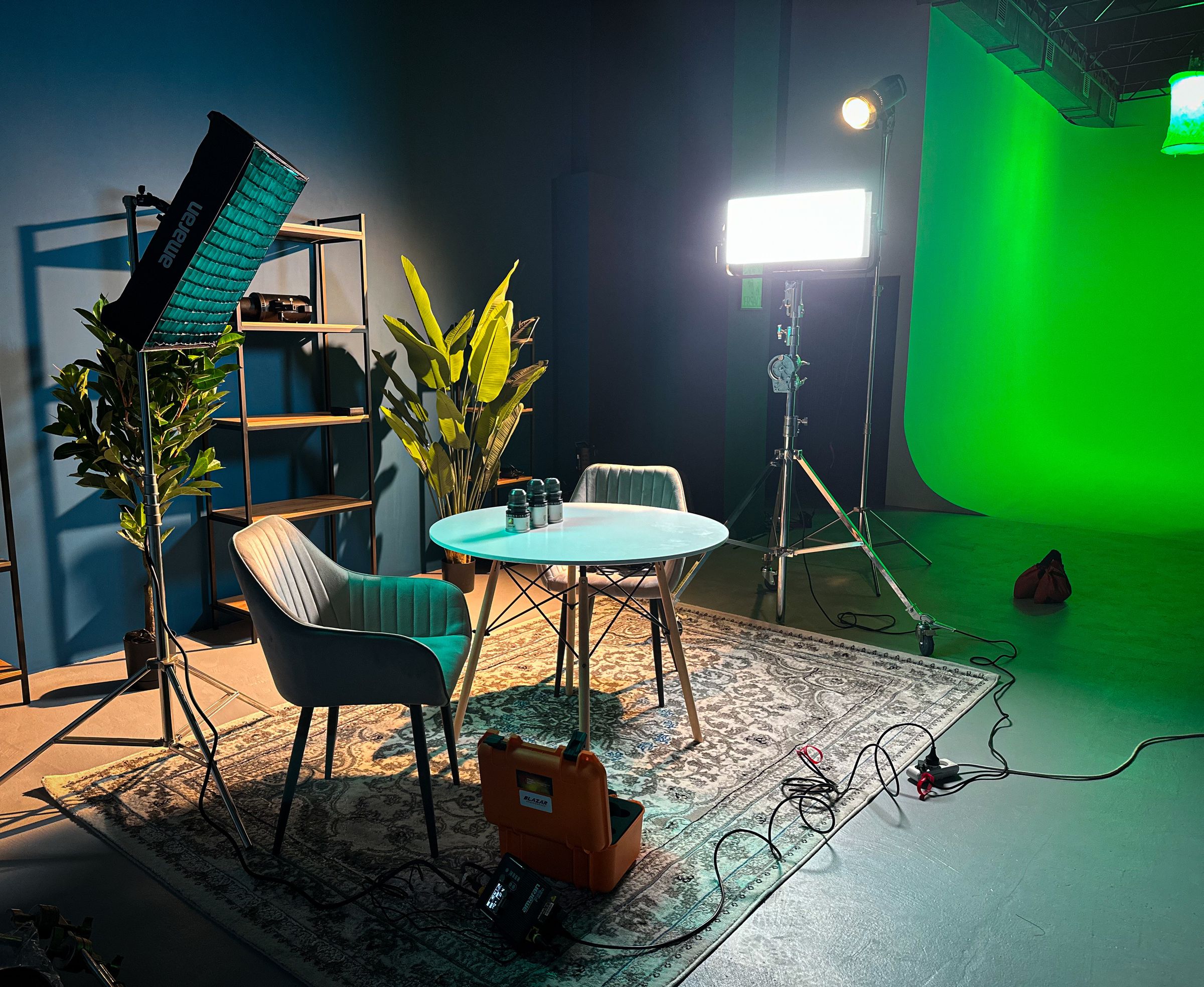
Chris Ernst on set — always thinking two problems ahead.
Being the Caddy, Not Just the Cart: How Ernst Thinks About the DP Relationship
Ernst has a friend — cinematographer Terrence Hayes — who goes back to colleges and asks students what the DP's job actually is. Camera? Lighting? Both? Hayes's answer catches most people off guard: the cinematographer's real job is being the director's best friend. Most of what a great DP does on set isn't about fixtures or f-stops — it's relationship management, trust-building, and creative problem-solving in real time.
For a gaffer, that means understanding where you fit in that dynamic. You're not just executing the DP's vision — you're protecting it. When the budget doesn't cover the exact setup the DP wants, your job is to find the path that gets them to the same place by a different route. Ernst uses the analogy of a golf caddy: sometimes you lay up instead of going for the green in one. That's not failure — it's course management.
He also points to how set culture has shifted over the last two decades. DPs like James Lexton represent a newer generation — mellow, collaborative, not the screaming authority figures some gaffers learned under. "Twenty years ago, you were terrified of the DP," Ernst said. That fear-based culture is mostly gone, and in his view, the work is better for it. Respect runs in all directions now.
HEAR THE FULL CONVERSATION
🎙 The Lamp Dock — Ep. 2: Chris Ernst
"From Film School to Hollywood Gaffer" — available on Spotify
Fashion House: How a San Diego Kid Became the Gaffer the DP Kept
Ernst's first real union credit happened because nobody else wanted it. Fashion House was a low-budget UPN show — each episode under $250,000 — and the rate for the gaffer reflected it. "All the old-timers didn't want to touch it," he said. The DP, looking for someone with energy and no ego about the budget, interviewed Ernst. "I like the kid," was the verdict. He got the pilot.
He'd already been gaffing 60–70% of student productions at San Diego State — not by ambition, but by accident. On an early college shoot, a crew member was about to plug into a hot Cam Lock. Ernst stepped in, stopped it, and the professor instantly made him the gaffer. He'd never planned on it. But that moment wired his brain for the job: read the situation, solve the problem, keep people safe.
After the Fashion House pilot, the DP's decision was simple: "I'm sticking with the kid." The show ran. Ernst made friends. He joined IATSE Local 495 in San Diego, worked Veronica Mars and Point Pleasant, and eventually made it to LA — pushed, as he puts it, by an ex-wife who gave him an ultimatum. He joined Local 728, grinded through the early years of a new city, and hasn't looked back since.
From Cam Locks to IP Addresses: The Tech Revolution Ernst Almost Missed
Chris Ernst made one of the worst predictions of his career around 2007. His roommate — a Navy engineer who could wire anything — suggested they get into the LED lighting business together. Ernst passed. "I told him it's going to be 30 years before we're using LED on a film set," he said. "Sure enough, five years later, every light I owned was an LED." He laughs about it now. He wasn't the only one who didn't see it coming that fast.
When he started, knowing what a Bates cable and a Cam Lock were was basically enough to get you on set. Now, Ernst spends afternoons setting up IP addresses for wireless DMX systems, matching XY color coordinates, referencing Rec. 709 color profiles. "I never thought I'd need to figure these things out," he said. "But that's just where the industry is going." The gaffers rising to the top are the ones who embrace the technology rather than resist it.
His truck package reflects how the job has changed. What used to be two five-ton trucks, a two-ton step van, and a full inventory of tungsten and HMIs has compressed into a sprinter van: four S60s, a Luster package, jokers in 400W and 800W, 1600 Astera tubes, and a tungsten backup. That lean kit handles about 80% of his work. For the big stuff — Sharpies, GLP movers, Septrons — he rents. "I can't own 700 lights when they're constantly changing," he said.
His gear philosophy is equally open-minded. He doesn't dismiss any fixture, no matter how small. "Even if it's just a stupid little clip-on light that runs on batteries — there can be a use for it on a film set." He'll throw Robe eye candy lights into backgrounds at Fox Sports. He'll use rotolys and dopios as visual texture. The light that looks out of place somewhere else might be exactly right in front of him.
What Chris Ernst Would Tell the Next Generation Coming Up
You're getting paid for your ideas — act like it. The difference between a gaffer people call back and one they don't isn't the truck size or the gear list. It's creative problem-solving under pressure. When the budget falls short or the location fights you, the gaffers who stay busy are the ones who never say "we can't" and always find the path to the right look.
Never say no without an alternative. "We can't do that" is a career-limiting answer. The move is: "We can't do exactly that, but let me figure out what gets us there." Every senior gaffer Ernst admires has this in common — they solve the problem in front of them instead of stopping at the obstacle.
Study light everywhere, not just on set. When you're in a restaurant, look at how the window light falls across the table. When you're outside at dusk, notice the color temperature shift. When you walk past a building with interesting shadows, ask yourself how you'd replicate that on a stage. The best gaffers are always filing away references. That library is what makes them fast when the DP calls an audible.
Know your overhead before you scale up. Ernst went from two five-ton trucks and employees to a sprinter van, and he's never looked back. "Overhead was huge," he said. For young gaffers building their package, the question isn't how much gear can you own — it's how much gear you need to own versus rent. Lean often wins.
Your relationships survive the credits. Ernst's best opportunities came from people he survived brutal 23-hour days with — friendships forged on the worst jobs, not the best ones. Be easy to work with. Show up with energy. Be the person who brings the creamed corn, not the one who eats it.
Embrace the title CLT. Ernst doesn't write "gaffer" on his time cards anymore — it's Chief Lighting Technician or Set Lighting Technician. The job has professionalized, the technology has advanced, and the credit should reflect it. Own the full scope of what you actually do on set.
More from the Lighting Guides
— Blockbuster-scale cinematic lighting from a Marvel veteran. Jeff Murrell — Marvel Blockbuster Lighting
— High-octane lighting strategy from an action film specialist. Michael Ambrose — Action Film Lighting
— Fifty years of cinematic lighting philosophy from a Hollywood legend. Jim Plannette — Film Lighting
— Key, fill, and back light placement for single and two-person setups. How to Light an Interview
— The technique every gaffer builds from. Three-Point Lighting: The Foundation of Every Great Shot
— Professional LED lighting for filmmakers, spec-checked and compared. Best LED Panels for Film Production (2026 Guide)
— Film lighting equipment for studio and location work. Best COB LED Lights for Film & Studio
Need help building your lighting setup?
Whether you're outfitting a studio or gearing up for a production, MACCAM has your back.

Chris Ernst and MACCAM founder Mac McDonald.
FROM THE TEAM AT MACCAM
🎙 The Lamp Dock Podcast
Interviews with Hollywood's top gaffers, lighting designers, and manufacturers.
Real talk about light, craft, and the business of film.